China Top 10 Bar Height Tables Manufacturers
China’s furniture industry offers a broad range of Bar Height Tables, from compact café pieces to custom tables for hotels and restaurants. This guide introduces ten manufacturers and explains what buyers should examine before requesting a quotation. Factory capacity matters, but it is only part of the picture. Materials, finish consistency, packaging, customization options, and sample quality deserve equal attention.
A table can look sturdy in a catalog and still disappoint in person. Check the tabletop edge, inspect the welds or joints, and confirm the finished height against the seating you plan to use. Charles Eames, the influential designer, said, “The details are not the details. They make the design.” That principle applies to bar-height furniture: small choices affect stability, comfort, and daily wear. Ask suppliers for clear specifications and recent product images, not only polished showroom shots.
The manufacturers featured here are intended to help buyers compare capabilities, product ranges, and potential fit—not to declare one universal winner. Some suppliers may suit large hospitality orders; others may be better for smaller runs or tailored finishes. A shortlist can still miss a strong local option. Use it as a starting point, then verify samples, lead times, and communication directly with each company.
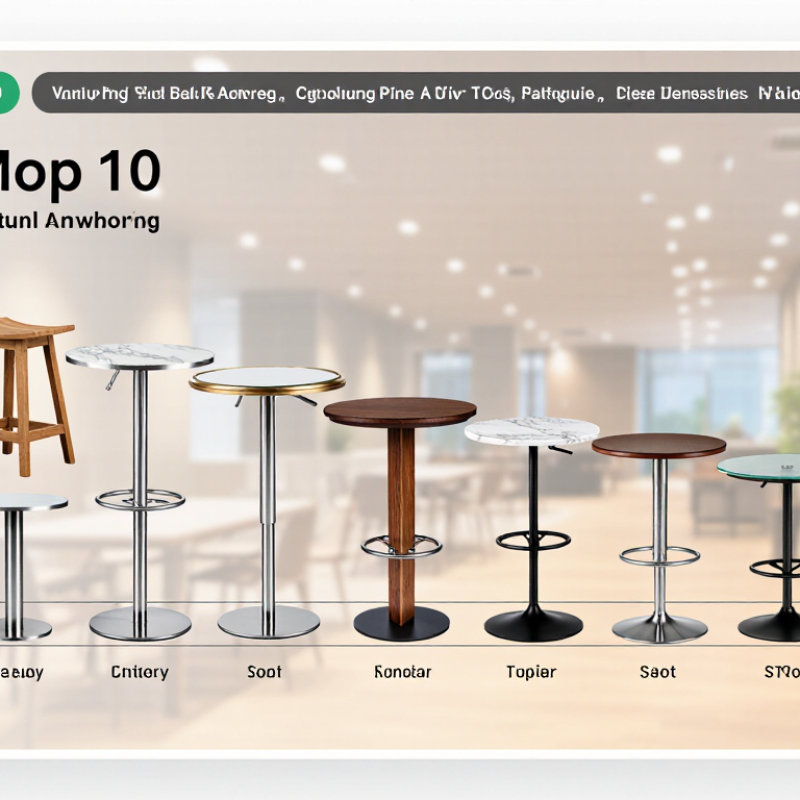
Bar-Height Tables Typically Measure 40–42 Inches; Counter Tables, 34–36 Inches
Bar-height tables usually stand 40–42 inches high, while counter-height tables are typically 34–36 inches. That four-to-eight-inch difference changes how people sit, reach, and move around a dining space. The National Kitchen & Bath Association’s planning guidance commonly uses 36 inches for counter surfaces and 42 inches for bar surfaces. These are useful reference points, not guarantees that every table will feel comfortable. A thick tabletop or uneven floor can alter the finished height.
For buyers comparing Chinese manufacturers, ask for the finished floor-to-tabletop measurement, not just the frame specification. Check stool-seat height too: a gap of roughly 10–12 inches between seat and tabletop often feels workable, but body size and cushion compression matter. Sit at a sample if possible. Small details show up fast. A footrest placed too high can leave shorter users dangling, while a low one may feel cramped. I would also verify measurements on the production sample; catalog numbers can be rounded.
Tips: Measure the room with stools pulled out. Leave a clear walking path, and confirm the table height after flooring and leveling feet are accounted for.
Typical Table Heights: Bar vs. Counter
Standard height ranges in inches
Bar-height tables typically measure 40–42 inches, while counter-height tables typically measure 34–36 inches.
Pair 40–42-Inch Tables with Bar Stools Featuring 28–30-Inch Seats
For buyers comparing China’s bar-height table manufacturers, dimensions deserve close attention. A 40–42-inch tabletop usually pairs well with stools offering 28–30-inch seat heights. This leaves roughly 10–14 inches between the seat and tabletop, a practical range for dining and relaxed conversation. Measure carefully.
The tabletop height alone does not tell the whole story. A thick apron or support rail can reduce knee clearance, especially for taller guests. Check the distance from the floor to the underside of the table, then compare it with the stool’s seat height. If possible, test a sample with the actual stool and let someone sit for several minutes. Knees should fit comfortably, and feet should rest naturally.
For production orders, confirm finished dimensions, not just catalogue estimates. Ask how the manufacturer controls height across multiple units, and request measurements from a completed sample. Small variations happen. A 42-inch table with a 30-inch seat may suit some users, but feel cramped when the frame has a deep apron. Room layout matters, too: leave enough space to pull stools back without blocking a walkway. A simple floor mock-up can reveal problems before delivery.
Compare Wood, Steel, and HPL Tabletops for Commercial Use
When comparing bar-height tables for commercial use, judge the complete tabletop, not just its surface. Solid wood offers warmth and can be refinished, but moisture and daily impacts may leave marks. Veneer can reduce material use, though damaged edges are harder to repair. The FAO’s 2022 Forest Products Yearbook reported global sawnwood production of about 446 million cubic metres. That scale signals broad material availability, not consistent quality. Check species, finish, and edge construction. Details matter.
Steel tops suit hard-use settings, but weight, noise, and visible scratches may frustrate staff. The World Steel Association reported 1.89 billion tonnes of crude steel production in 2023; this is industry context, not proof that a particular tabletop will last. High-pressure laminate (HPL) is often practical for cafés: it offers a wipe-clean surface and many finish options. Yet seams, corners, and the substrate beneath the laminate deserve close inspection. Ask for test results, cleaning guidance, and warranty terms. For a busy counter, compare resistance to heat, stains, and impact under the same test conditions. A polished sample can mislead. Buyers sometimes overlook table bases and daily maintenance, then blame the top.
China Top 10 Bar Height Tables Manufacturers - Compare Wood, Steel, and HPL Tabletops for Commercial Use
Commercial procurement comparison: Ten common bar-height table construction types are compared below. These are material and construction categories, not a ranked list of named manufacturers.
| No. | Tabletop construction | Typical top thickness* | Moisture and stain performance | Heat and scratch considerations | Common commercial applications | Care and procurement checks |
|---|---|---|---|---|---|---|
| 1 | Solid hardwood Oak, beech, or other hardwood boards | 25–40 mm (about 1–1.6 in) | Needs a sound sealed finish; standing water can mark the surface or affect joints. | Can be refinished, but may dent or scratch; use trivets for hot cookware. | Restaurants, pubs, cafés, and hospitality interiors where a natural wood appearance is desired. | Ask about wood species, moisture content, finish system, board-joint construction, and refinishing instructions. |
| 2 | Wood veneer on plywood Real-wood veneer bonded to a plywood core | 18–30 mm (about 0.7–1.2 in) | Surface protection depends on the finish; exposed edges and damaged finish can allow moisture ingress. | Veneer is thinner than solid wood and cannot be sanded repeatedly; protect from sharp impacts and hot items. | Dining areas and lounges seeking a wood look with a stable engineered panel. | Check veneer thickness, edge treatment, core grade, and whether the finish is suitable for frequent cleaning. |
| 3 | High-pressure laminate (HPL) on particleboard | 25–38 mm (about 1–1.5 in, including core) | HPL faces resist many everyday spills; unsealed seams and edges may be vulnerable to water. | Generally easy to clean and resistant to everyday wear; not immune to chips, deep scratches, or direct high heat. | High-turnover cafés, food-service spaces, and casual dining areas. | Confirm HPL grade, core material, edge profile, seam sealing, and cleaning-chemical compatibility. |
| 4 | HPL on plywood Decorative HPL bonded to a plywood core | 18–30 mm (about 0.7–1.2 in) | HPL provides a cleanable face; edges and joints still need suitable protection from moisture. | Face performance is similar to other HPL surfaces; the panel can chip or be damaged by concentrated impact. | Commercial dining where a durable decorative surface and a plywood panel are specified. | Request details on plywood grade, laminate bonding, edge banding, and intended indoor or outdoor use. |
| 5 | Compact laminate Solid-core high-pressure laminate panel | 10–13 mm (about 0.4–0.5 in) | Typically moisture resistant throughout the panel; confirm product suitability for the exposure and installation. | Durable for many commercial uses, but edges can be damaged by severe impact; use trivets for very hot items. | Busy cafés, bars, and settings where a slim, low-maintenance top is preferred. | Check panel thickness, support spacing, edge finish, fixing method, and manufacturer load guidance. |
| 6 | Solid surface Acrylic- or polyester-based mineral-filled surface, often supported by a substrate | Commonly about 12 mm surface sheet, with overall build-up varying by design | Nonporous surfaces are generally easy to clean; follow the supplier’s guidance for stains and disinfectants. | Can scratch and may be damaged by high heat; many surface scratches can be repaired, depending on the product. | Bars and hospitality interiors requiring a seamless-looking surface or integrated details. | Clarify surface composition, substrate, seams, repair method, and heat limitations. |
| 7 | Stainless-steel-clad top Stainless sheet over a rigid support core | Often 0.8–1.5 mm steel skin over a substrate; total top thickness varies | Stainless steel is corrosion resistant, but grade, finish, cleaning products, and exposure affect performance. | Can scratch and show fingerprints; hot items may transfer heat to the top and its support structure. | Bars, cafés, and service areas where a hygienic, wipe-clean metal surface is useful. | Specify stainless grade, sheet thickness, brushed or polished finish, core, edge detail, and cleaning instructions. |
| 8 | Porcelain or ceramic slab Large-format surface fixed to a structural support | Commonly 6–12 mm slab, usually installed with a supporting substrate | Many porcelain surfaces have low water absorption; joints and edges remain important to the complete assembly. | Surface is generally hard and scratch resistant, but edges can chip and concentrated impact can cause breakage. | Hospitality spaces seeking a stone-like appearance and a hard-wearing surface. | Check slab support, edge protection, joint design, impact guidance, and the supplier’s cleaning recommendations. |
| 9 | Tempered-glass top Glass panel mounted on a compatible frame or base | Commonly 8–12 mm, depending on panel size and support design | Nonporous and easy to wipe; fingerprints and smudges are readily visible. | Resists many surface scratches in normal use, but can break from impact or edge damage; use heat-resistant pads as advised. | Bars and lounges where a transparent or visually light tabletop is preferred. | Specify tempered safety glass, polished edges, support points, panel dimensions, and replacement procedure. |
| 10 | Powder-coated steel top Formed steel sheet with a protective coating | Often about 1–2 mm sheet, with stiffness depending on formed edges and support | Coating protects the steel when intact; chips or damaged areas may expose the metal to corrosion. | Coating can chip or scratch under hard impact; avoid abrasive cleaning that can damage the finish. | Industrial-style cafés, patios with suitably specified products, and casual dining areas. | Confirm steel thickness, coating specification, corrosion protection, drainage details, and indoor/outdoor rating. |
General sizing note: Bar-height tables commonly have an overall height of approximately 40–42 in (1,016–1,067 mm); exact dimensions vary by product and local design requirements. Thickness ranges above are indicative examples, not universal standards. Confirm structural capacity, dimensions, finish, and suitability for the intended commercial environment with the supplier before ordering.
Assess Strength and Stability Under EN 15372:2016 for Non-Domestic Tables
For a “China Top 10 Bar Height Tables Manufacturers” shortlist, assess more than appearance and quoted load capacity. EN 15372:2016, published by CEN, sets strength, durability, and safety requirements for non-domestic tables. It uses three severity levels, helping buyers match testing to the table’s intended use. EN 1730:2012 provides related test methods. Ask suppliers for dated test reports that identify the tested model, configuration, and severity level.
Bar-height tables deserve close stability checks. Their taller legs and elevated tops can make side loads more concerning in busy cafés or staff areas. Review test evidence for stability, horizontal and vertical loading, and repeated-use durability. Check whether the report covers the exact base, fasteners, and tabletop you plan to order; a result for a different configuration may not transfer. Small details matter. A loose foot or uneven floor can change how a table feels in daily use. Test setup also varies between operators, so record any doubts rather than treating a pass as the whole story.
Tip: During a factory visit, place the table on a level surface and inspect each joint, foot, and fixing. Then ask to see the EN 15372:2016 report, not just a “tested” claim.
Rank China’s Top 10 Manufacturers by MOQ, Lead Time, and Export Capability
Ranking China’s top 10 bar-height table manufacturers by MOQ, lead time, and export capability gives buyers a practical starting point. A low minimum order quantity suits a café testing a new layout, while larger projects may prioritize stable production capacity. Compare each supplier’s stated MOQ with the quantity they will actually accept for custom finishes or dimensions. Details matter.
Lead time should include more than factory production. Ask how many days are needed for sample approval, packaging, and dispatch, then confirm whether the estimate changes during peak seasons. A quoted 30-day schedule may not include shipping. That assumption can fail. Request a written timeline tied to the exact table design and order volume.
Export capability is best judged through verifiable process details, not broad claims. Check whether the manufacturer can provide packing specifications, export documentation, and clear communication about shipment milestones. Ask for photos of carton protection, especially around metal legs and tabletop corners. A polished catalog is useful, but it does not prove consistent service. Rankings should weigh these three factors transparently and note missing information; otherwise, a precise-looking top-ten list can create false confidence.