Blog.

Blog2024-04-08T12:48:33+02:00

How to Choose Ordinary Plywood for International Sourcing?

Choosing Ordinary Plywood for international sourcing requires more than comparing factory prices. Buyers must examine panel construction, wood species, adhesive quality, surface condition, and declared performance. Ordinary Plywood is often treated as a basic commodity, yet small specification differences can affect furniture stability, packaging strength, and project safety.

Industry data shows why careful evaluation matters. The FAO Forestry Production and Trade database classifies plywood within broader wood-based panel categories, but definitions and reporting practices differ across markets. The FAO and UNECE Forest Products Annual Market Review also highlights continuing volatility in timber supply, energy costs, and transport conditions. These factors can change landed costs quickly. A low quotation may not remain economical.

Check the details.

Experienced buyers should request samples, mill test reports, production photographs, and recent inspection records. Verify thickness tolerance, core gaps, moisture content, bonding performance, and formaldehyde emissions. Relevant standards may include ISO 12465, EN 636, or destination-market requirements, depending on the application. Certification claims should be traceable, not merely printed on a brochure. Chain-of-custody systems, such as FSC certification, may support responsible sourcing, but they do not automatically prove panel quality.

Supplier communication also deserves scrutiny. Ask whether the quoted grade is commercial, utility, or project-specific. Confirm packaging, container loading, fumigation responsibilities, and replacement procedures before ordering. Some buyers focus heavily on price. That is understandable, but incomplete. An apparently cheaper panel may contain more repairs, uneven cores, or higher wastage. The better decision combines verified quality, documented compliance, stable supply, and realistic total cost. Perfect certainty is unlikely. A disciplined sourcing process still reduces avoidable surprises.

How to Choose Ordinary Plywood for International Sourcing?

Define Ordinary Plywood and Its International Applications

Ordinary plywood is a general-purpose panel made by bonding thin wood veneers in alternating directions. This cross-layer structure improves strength and reduces warping. Unlike marine or structural plywood, it may have simpler veneers, less durable glue, and limited resistance to moisture. The term “ordinary” is not a universal international grade. Its meaning can change between suppliers and markets.

It is commonly used for furniture backs, interior partitions, packaging boxes, temporary shop fittings, and general construction. In international trade, buyers may also use it for shelving, door cores, exhibition panels, and low-load furniture parts. A warehouse in a dry climate may accept a lower moisture resistance level. A humid destination should not. That difference matters.

I have found that clear specifications prevent more problems than attractive samples. Buyers should confirm thickness, veneer species, core gaps, surface quality, panel size, moisture content, and adhesive emission data. Samples should be checked after transport, not only before shipment. A panel can look smooth and still contain weak inner layers. It is not glamorous.

Export documents should match the actual cargo, including packing details and test reports where required. Local building rules and chemical emission limits also need verification before purchase. A supplier’s certificate helps, but it is not proof by itself. Some buyers focus too heavily on price; I have made that mistake. The cheaper panel may require extra sanding, replacement, or stronger packaging, making the final cost higher.

How to Choose Ordinary Plywood for International Sourcing?

Ordinary plywood is a general-purpose engineered wood panel made by cross-laminating thin veneer layers with adhesive. It is commonly sourced for packaging, furniture components, interior partitions, shelving, and non-specialized construction uses. The chart shows typical thickness selections; actual requirements depend on span, load, moisture exposure, and local standards.

Reference context: Common commercial plywood thicknesses include 6, 9, 12, 15, and 18 mm. For international sourcing, confirm veneer species, grade, formaldehyde class, panel dimensions, moisture resistance, and compliance with applicable standards such as EN 636 or equivalent national specifications.

Identify Required Plywood Grades, Sizes, and Performance Standards

When sourcing ordinary plywood internationally, define the required grade before discussing price. A supplier’s word “commercial” may describe appearance, not structural performance. For dry interiors, request an interior-use panel with controlled face defects and a documented core. For humid rooms or transport packaging, specify moisture-resistant adhesive, not merely a polished surface. ISO 12465 classifies plywood by general requirements, while EN 636 separates panels by service environment. These references reduce confusing terminology between markets.

Size selection should match the cutting plan. Common sheets measure 1,220 × 2,440 mm, but 1,250 × 2,500 mm formats can reduce waste in some factories. Confirm thickness tolerance, squareness, flatness, and usable face dimensions. A 12 mm panel that arrives at 11.4 mm may fail a tight assembly. Small details matter. ASTM D1037 testing evaluates properties such as bending, bonding, and dimensional stability. Ask for test results from the actual production batch, not an old generic certificate.

The FAO Global Forest Products Facts and Figures 2023 reported more than 370 million cubic metres of wood-based panels produced globally in 2022. That scale creates many quality levels. Compare veneer species, core void limits, formaldehyde class, and moisture content in writing. Formaldehyde emissions may be checked against EN 717-1 or equivalent methods. I have found that a simple sample inspection often reveals more than a glossy datasheet. Still, one sample cannot represent every shipment. Recheck randomly, and leave room to revise the specification when field performance disagrees.

Evaluate Core Materials, Veneer Quality, and Manufacturing Processes

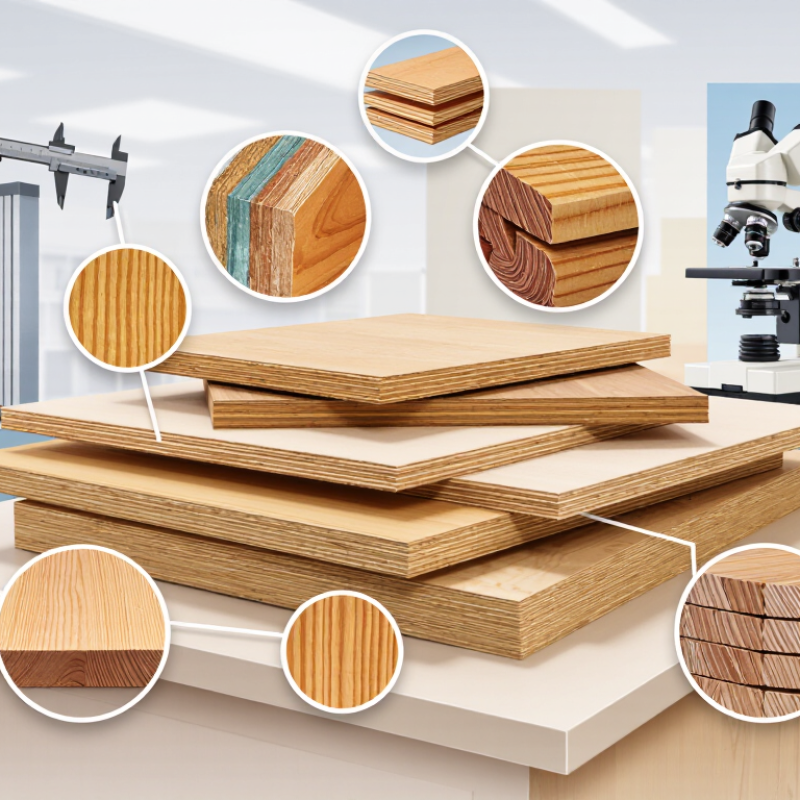
When sourcing ordinary plywood internationally, start with core construction, not the surface. Examine the plies at a freshly cut edge. Their thickness should look consistent, with few gaps or overlapping joints. Poplar, eucalyptus, birch, and mixed hardwood cores behave differently in weight, stiffness, and moisture response. Ask for the species mix, target density, adhesive type, and formaldehyde class. A low price can hide a weak inner layer. I once accepted attractive samples that warped after a humid sea journey. The mistake was trusting appearance over conditioning data.

Tips: Compare three samples from different production batches. Measure thickness at several points with a calibrated gauge. Check veneer faces for open knots, splits, patches, sanding burns, and color variation. A smooth face is not automatically a durable face. Request moisture readings before shipment, plus test reports showing bonding strength and panel tolerance. If reports lack sampling dates, question their reliability. Ask the factory to photograph core layup and pressing records. These records are useful, though photographs cannot replace independent inspection.

Compare
Measure
Inspect

Manufacturing discipline often determines whether ordinary plywood performs consistently. Review drying, veneer peeling, layup, hot pressing, trimming, sanding, and packing controls. Press temperature and time should match the panel thickness and adhesive system. Inspect edge sealing when containers may face damp conditions. Confirm pallet protection, corner guards, and ventilation gaps. Your purchase specification should define thickness tolerance, face grade, core defects, moisture range, and allowable repairs. Leave room for honest uncertainty. Wood varies naturally, and one inspection cannot predict every panel. A small trial order may reveal problems that polished samples conceal.

Verify Supplier Credentials, Certifications, and Quality Control

When sourcing ordinary plywood internationally, supplier verification should begin before price negotiation. Ask for the registered company name, factory address, production scope, and export history. Compare these details with independent business records and shipping documents. A trading office may not control the factory. Request a live video tour or an on-site audit. Look for log storage, veneer drying equipment, calibrated presses, and clearly separated finished goods. Small details often reveal whether paperwork matches real operations.

Treat certifications as evidence, not decoration. Check the certificate number, issuing organization, covered products, production site, validity dates, and audit scope. Confirm them through the issuer’s public database whenever possible. Ask for recent test reports covering thickness tolerance, moisture content, bonding strength, formaldehyde emissions, and surface defects. Reports should identify the tested product and batch. A generic PDF is weak evidence. It may be accurate, but it may also be outdated.

Before placing a large order, approve a signed sample and define acceptance limits in writing. The supplier should explain incoming veneer inspection, glue control, pressing temperature, sanding, packing, and final sampling. Request batch photos, inspection records, and corrective-action reports. An independent inspector can check random cartons before shipment. Do not rely on one successful sample. Plywood can vary between batches, especially when moisture control is inconsistent. That risk deserves a second review.

Compare Pricing, Packaging, Shipping Terms, and Import Requirements

When sourcing ordinary plywood internationally, compare more than the quoted unit price. Ask suppliers to price identical thicknesses, dimensions, face grades, core structures, and moisture levels. A cheap panel may contain more repairs or produce greater cutting waste. Request both small-order and full-container pricing. Include inspection fees, inland transport, port charges, insurance, duties, and taxes when calculating landed cost per usable sheet.

Packaging should match the journey. Ask for strong pallets, corner protection, waterproof wrapping, and clear sheet labels. Photographs before loading can reveal loose straps or exposed edges. Confirm the number of sheets per pallet and the pallet’s treatment status. Over-packed cargo costs more, but weak packaging can cause swollen edges and rejected panels. I once focused too heavily on the product price and underestimated repacking costs. That mistake still influences my purchase checks.

Shipping terms require careful comparison. Under FOB, verify who handles export clearance and origin charges. Under CIF, check which destination fees remain unpaid. DDP may appear simple, but confirm whether the seller can legally manage import procedures in your market. Before ordering, check tariff classification, formaldehyde or emissions standards, labeling rules, and required wood-packaging documents. Prepare the commercial invoice, packing list, transport document, and origin evidence when applicable. Customs requirements can change. Confirm them with local authorities or a qualified broker, not only with a supplier’s email.

How to Choose Ordinary Plywood for International Sourcing? - Compare Pricing, Packaging, Shipping Terms, and Import Requirements
Category Comparison Dimension Common Option Typical Data or Requirement International Sourcing Consideration
Product Specification Standard sheet size 1220 × 2440 mm The most widely traded metric plywood size. Other common sizes include 1250 × 2500 mm and 1220 × 3050 mm. Confirm whether the destination market uses metric or imperial sheet dimensions before placing the order.
Typical thickness 5–18 mm Common commercial thicknesses include 5, 9, 12, 15 and 18 mm. Actual thickness tolerance should be agreed in the purchase specification. Request a thickness tolerance, face-sanding requirement and calibrated measurement method in writing.
Core material Poplar, eucalyptus or mixed hardwood Core species affect density, screw-holding performance, bending strength, weight and price. Ask for the core composition and veneer lay-up rather than relying only on the general term “commercial plywood.”
Bonding classification Interior or moisture-resistant glue Interior-grade panels are generally intended for dry conditions. Exterior or weather-resistant panels require a suitable durable adhesive and manufacturing specification. Do not treat “waterproof” as a universal technical grade; request the applicable test standard and test report.
Surface quality Utility, B/C or C/D-type appearance Lower-cost ordinary plywood may contain repaired knots, open knots, core gaps, color variation and visible patches. Define face grade, back grade, allowable defects, patch limits and edge condition using approved samples or photographs.
Indicative Pricing 5–9 mm ordinary plywood Indicative export range Approximately USD 220–420 per m³ on an export basis, depending on species, glue, grade, thickness tolerance, order volume and market conditions. Use this only as a budgeting range. A written quotation should state currency, validity period, quantity and trade term.
12–18 mm ordinary plywood Indicative export range Approximately USD 230–450 per m³ on an export basis. Higher density, better face quality and stricter testing normally increase the price. Compare offers on the same thickness, sheet size, density, glue class, packaging and delivery term.
Price unit Per m³, sheet or container Export quotations may be stated per cubic metre, per sheet or per container. The same order can show different apparent prices when units differ. Convert every quotation to a landed cost per sheet or per m³ before comparing suppliers.
Landed-cost items Product plus logistics and import costs Potential additions include inland transport, export documentation, ocean freight, insurance, customs duty, import VAT or GST, inspection fees, port charges and local delivery. A low factory price may not produce the lowest total cost after freight, duty and destination charges.
Packaging Standard packing method Flat bundles on timber skids Panels are normally stacked by size and thickness, protected with moisture-resistant material, strapped and placed on skids or pallets. Specify bundle quantity, maximum bundle weight, corner protection and whether skids are included in the quoted volume.
Moisture protection Plastic film, kraft paper or container liner Packaging can reduce exposure to rain and condensation but cannot correct high panel moisture or poor container conditions. Request dry, clean containers and consider desiccants or a container liner for long ocean voyages and humid routes.
Wood packaging compliance ISPM 15 treatment and marking Solid-wood pallets, skids, crates and dunnage used in international trade generally need compliant treatment and an official ISPM 15 mark. Confirm that all solid-wood packaging is compliant; plywood itself is processed wood and is generally treated differently from solid-wood packaging.
Loading plan Volume- or weight-limited loading A 20-foot dry container commonly accommodates about 21–26 m³ of plywood, while a 40-foot high-cube container may accommodate about 50–58 m³, subject to weight and packing design. Obtain a packing list with bundle dimensions, gross weight, net weight and estimated loading quantity before booking freight.
Shipping Terms EXW Ex Works The buyer normally arranges pickup, export clearance, main carriage, insurance and import clearance from the named place. Suitable for buyers with established logistics control; verify that export formalities can legally be handled by the buyer or its agent.
FOB Free On Board, named port The seller normally handles delivery to the port, export clearance and loading on board. The buyer arranges ocean freight, insurance and import procedures. Compare FOB offers using the same named port and container type. Confirm who pays origin terminal and documentation charges.
CIF Cost, Insurance and Freight The seller arranges cost, basic marine insurance and freight to the named destination port. Risk generally transfers when goods are loaded on board at the shipment port. CIF does not normally include destination customs duty, VAT, terminal charges, customs brokerage or inland delivery.
DAP or DDP Delivered at Place or Delivered Duty Paid DAP usually excludes import duties and taxes. DDP places substantially more import responsibility on the seller, where legally permitted. Confirm the exact delivery address, unloading responsibility, tax treatment and importer-of-record arrangement before accepting a delivered quotation.
Import Requirements Customs classification HS heading 4412 Plywood and similar laminated wood products are generally classified under HS heading 4412, but the precise national subheading depends on face wood, construction, thickness and destination-country rules. Obtain a tariff ruling or confirmation from the destination customs authority or licensed customs broker before shipment.
Core import documents Commercial invoice, packing list and bill of lading The invoice should identify product description, quantity, unit price, total value, currency, origin and trade term. The packing list should show bundle and container details. Ensure all documents use matching product descriptions, quantities, weights, marks and consignee information.
Origin documentation Certificate of origin where required A certificate of origin may be required for customs clearance or preferential tariff treatment, depending on the destination and applicable trade agreement. Do not claim preferential duty without verifying the applicable rules of origin and required certificate format.
Formaldehyde or emissions rules Destination-market compliance Some markets require formaldehyde-emission compliance or documentation, such as applicable TSCA Title VI requirements in the United States or relevant European emission classifications and standards. Confirm the destination regulation, panel category, test method, laboratory qualification, labeling and record-retention requirements before production.
Plant-health controls Phytosanitary and wood-packaging checks Country rules may apply to solid-wood packaging, untreated wood materials or certain wood products. Processed plywood may receive different treatment from solid timber. Check the destination plant-quarantine authority and provide compliant ISPM 15 packaging evidence where applicable.
Quality Control Pre-production approval Written specification and reference sample Approve species, thickness, dimensions, face grade, glue type, density target, moisture range, sanding and packaging before mass production. A retained control sample helps resolve disputes about appearance and workmanship.
Inspection timing During production and before shipment Check dimensions, quantity, visual defects, delamination, edge quality, moisture and packaging before the container is sealed. For higher-value orders, use an independent inspection company and define the acceptance sampling plan in the purchase contract.
Common test evidence Bonding, moisture, density and emissions reports The required tests depend on the intended use and destination market. Test reports should identify the exact product construction and production batch. Avoid accepting generic reports that do not match the ordered species, thickness, glue system or manufacturing site.
Contract protection Specification, tolerance and claim procedure The contract should state allowable tolerances, inspection rights, non-conformance remedies, replacement terms, payment milestones and governing law. Link the final payment to approved inspection documents when commercially and legally appropriate.
Data note: Pricing, container capacity and import procedures are indicative planning data only. Actual requirements vary by origin, destination, product construction, season, freight market, customs classification and applicable national regulations.