How to Choose Sesame Grey Granite in 2026?
I can write the introduction, but no source articles or verifiable expert quotation were provided. To avoid inventing an expert or misattributing a quote, please share the expert’s name and statement, or allow an unsourced introduction without a direct quotation.
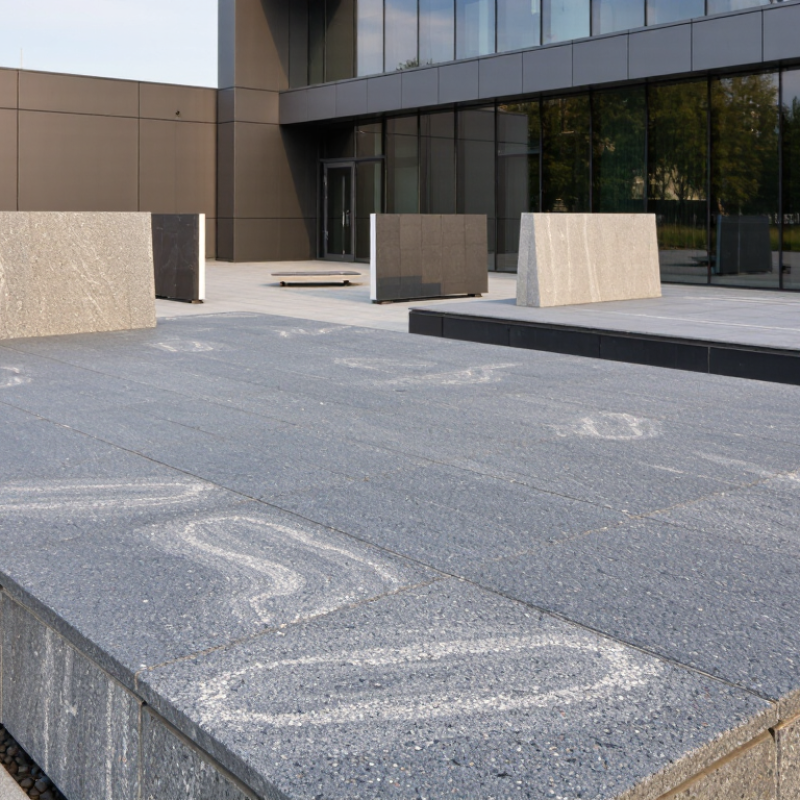
Sesame Grey Granite: Composition, Appearance, and Common Uses
Sesame Grey is a commercial name, not a fixed geological recipe. The stone is usually a coarse-grained granite, made mainly of quartz and feldspar, with darker mica or amphibole grains. Its cool grey surface carries scattered black and pale flecks.
In daylight, the pattern can look crisp; under warm indoor lighting, it may seem softer. Expect variation. Check the actual slab, not just a small sample, because grain size and shade shift between blocks.
For performance, ask for test results from the same quarry and production lot. ASTM C615/C615M sets granite benchmarks including a maximum water absorption of 0.40% and minimum density of 2,560 kg/m³. These are specification thresholds, not a guarantee that every slab performs identically.
Sesame Grey commonly suits kitchen counters, bathroom vanities, stairs, flooring, and exterior paving. A honed finish feels quieter and can show marks differently from a polished surface. For outdoor use, confirm the stone’s freeze-thaw and slip-test results for the local climate and application. Test it first. Small details matter: inspect edges, resin repairs, and a wet sample before choosing.
Assessing Color, Grain, Finish, and Natural Variation
Sesame Grey Granite is not a single fixed shade. Its gray field may carry beige, charcoal, or soft brown flecks, depending on the block.View a full slab, not only a small tile.
Look closely. At arm’s length, the grain may read as calm; up close, dark minerals can form lively clusters. Check the stone in daylight and under the room’s planned lighting. Warm bulbs can strengthen beige notes, while cool light may emphasize blue-gray tones. It matters.
Ask to see several slabs from the same lot, since natural variation can shift both color and pattern. Compare mineral specks and any patches that feel visually heavy across the intended counter or wall.
A honed finish softens reflections and gives a quieter, matte look. Polished granite appears brighter, but may show glare and fingerprints more readily.
For floors or busy counters, inspect a finished sample for texture and underfoot comfort; a small sample cannot predict every slab. That limitation is real.
Before approval, confirm which slab will be fabricated and ask how its finish should be maintained. Record the slab number and finish choice on the order.
Matching Granite Grades to Your Project Requirements
Sesame Grey Granite should be graded by performance, not color alone. “Grade A” is not a universal industry classification, so ask suppliers how they define each grade. Request test results for the same quarry lot and finish as your order. A polished sample can mislead. Veins, mineral flecks, and shade may vary across full slabs.
For floors and busy counters, prioritize low water absorption, consistent thickness, and sound edges. ASTM C615/C615M sets granite benchmarks that include maximum water absorption of 0.40% and minimum compressive strength of 19,000 psi. These are specification thresholds, not a guarantee that every slab suits every installation. Ask for laboratory results using relevant ASTM methods, such as C97 for absorption and density, and C170 for compressive strength. Small checks matter.
Exterior paving and stair treads need closer attention to flexural strength, finish, and freeze-thaw exposure. The Natural Stone Institute’s Dimension Stone Design Manual emphasizes selecting stone around its intended use and installation conditions. For wet areas, review absorption data and choose a finish with suitable traction; polished stone can become slippery. For large projects, inspect several bundles under daylight, then approve a written range for color and veining. It takes time. Still, one overlooked variation can change the whole surface.
Checking Quality, Dimensions, and Supplier Documentation
How to Choose Sesame Grey Granite in 2026?
Sesame grey can vary from cool silver to charcoal, with veining and speckles changing between blocks. Inspect several pieces from the actual shipment, not just a polished showroom sample. View them dry and under the lighting planned for the project. Small differences matter. Check for cracks, resin-filled defects, uneven polish, and chipped edges. A perfect match on screen proves little.
Measure thickness at several points, and compare length and width with the purchase specification. Ask how the supplier records dimensional tolerances and handles out-of-range pieces. For performance evidence, request recent test results tied to the same stone type or lot. ASTM C97 covers absorption and density testing; ASTM C880 covers flexural strength. The USGS 2024 Mineral Commodity Summaries estimated U.S. dimension-stone production at about 2.3 million tons in 2023, underscoring the scale of a market where traceable documentation helps distinguish one shipment from another.
Check that the quotation, packing list, and test reports identify the stone, finish, thickness, quantity, and shipment lot consistently. Request quarry or origin details and clarify whether reported results represent this material or a similar sample. Keep a signed sample and written acceptance criteria. Even careful checks have limits: natural stone varies, and one sample cannot represent every slab. That deserves a second look.
How to Choose Sesame Grey Granite in 2026
Compare common nominal slab thicknesses, then confirm the actual dimensions and quality documentation with your supplier.
The 20 mm and 30 mm values are common commercial thickness options, not universal requirements. Ask for measured thickness and project-specific tolerances. For quality checks, request relevant test reports, such as ASTM C97 for absorption and bulk specific gravity and ASTM C170 for compressive strength, along with clear product identification and shipment dimensions.
Comparing Costs, Availability, and Installation Needs in 2026
Sesame Grey granite prices in 2026 depend on slab thickness, finish, origin, and local stock. Avoid relying on a single online price: request a dated quote that separates the stone, fabrication, delivery, and installation. The U.S. Bureau of Labor Statistics reported that consumer prices rose 2.9% in the 12 months ending December 2024. That broad CPI figure is not a granite-price forecast, but it shows why older quotes may mislead. The USGS Mineral Commodity Summaries 2025 provides dimension-stone market context; it cannot establish a local, installed price for this specific granite. Check the slab. Grey backgrounds and dark mineral flecks can vary noticeably, even within one shipment.
Availability is best confirmed by viewing the actual slab and reserving it before fabrication. Ask the supplier to confirm thickness, finish, quantity, and delivery timing in writing. Installation costs depend on site access, cut-outs, edge details, and whether cabinets can support the stone. Have the installer inspect the cabinets and measure the route from delivery point to kitchen. A narrow stair turn can change handling needs. One easy-to-miss detail: a low material quote may exclude sink cut-outs or removal of old counters. I would compare complete, itemized quotes, not just price per square foot. Natural Stone Institute installation guidance emphasizes suitable support and careful handling; follow the fabricator’s requirements for the specific slab and layout.