How to Choose the Best Galvalume Corrugated Sheet?
Choosing the right Galvalume Corrugated Sheet requires more than comparing prices or surface brightness. The best option depends on roof design, local weather, structural loads, and installation conditions. A coastal building may need stronger corrosion protection than a dry inland warehouse. Salt air is unforgiving.
Galvalume steel combines aluminum, zinc, and silicon in a metallic coating that helps protect the underlying steel. However, coating performance varies with thickness, profile, substrate quality, and manufacturing control. Check the sheet thickness, coating designation, yield strength, and certified test results before ordering. Ask whether the supplier follows recognized standards, such as ASTM or EN requirements, where applicable. Product documents should clearly identify dimensions, tolerances, coating weight, and recommended fasteners.
Do not judge quality by appearance alone. A clean surface can still hide uneven coating or weak forming. Inspect sample edges, fastening holes, overlap details, and painted areas when possible. Experienced installers often notice small problems, such as cracking around cut edges or oil-canning across wide panels. Their feedback is valuable, but it should support documented specifications, not replace them.
No checklist is perfect. Real projects change.
This guide will compare practical selection factors, including roof pitch, panel profile, coating durability, thickness, supplier reliability, and total lifecycle cost. It will also explain common purchasing mistakes and show how to evaluate quotations fairly. A cheaper sheet may reduce the initial budget while increasing maintenance demands later. Careful decisions begin with verified information, realistic site conditions, and a clear understanding of how the sheet will perform over time.
What Is a Galvalume Corrugated Sheet?
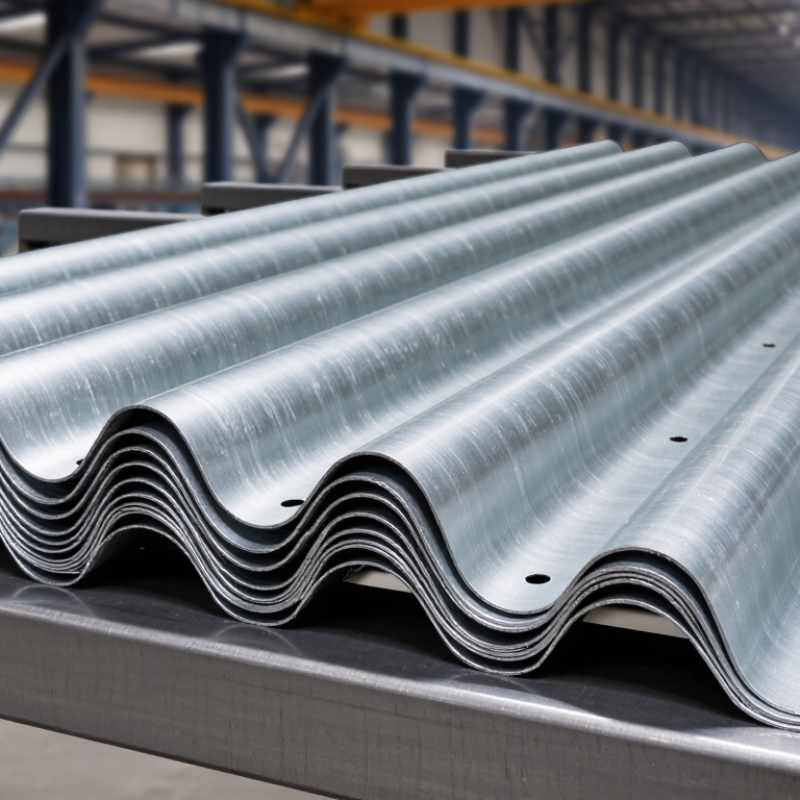
A galvalume corrugated sheet is a profiled steel panel protected by an aluminum-zinc-silicon coating. The coating usually contains about 55% aluminum, 43% zinc, and a small amount of silicon by weight. Aluminum helps resist heat and atmospheric corrosion. Zinc offers sacrificial protection when the surface receives minor scratches. The corrugation increases stiffness, allowing the sheet to span roofing supports with less deflection.
Its surface often appears silver-gray, with a fine crystalline pattern. That appearance is normal, not a coating defect. In practical roof inspections, water usually enters through poor overlaps, exposed fasteners, or damaged cut edges. The sheet itself may not be the main problem. Galvalume performs well in many rural, commercial, and industrial settings, but constant contact with wet concrete, treated timber, or dissimilar metals can accelerate corrosion.
When choosing a sheet, check the base steel thickness, coating mass, profile depth, and verified production standard. A thicker panel is not automatically better if its coating is inconsistent. Ask for test records, dimensional tolerances, and clear guidance for cutting and fastening. Avoid dragging sheets across one another; tiny scratches can become visible rust points. Use compatible fasteners and keep cut edges away from standing water. I have found that installation details often matter more than attractive surface color. Still, color and appearance can influence heat gain, so they should not be ignored. The perfect sheet does not exist. Selection always involves climate, structure, budget, and maintenance expectations.
Which Performance Requirements Should You Identify?
How to Choose the Best Galvalume Corrugated Sheet?
Which Performance Requirements Should You Identify?
Start with the environment, not the appearance. Coastal air, industrial emissions, humidity, and frequent temperature changes can accelerate corrosion. ASTM A792/A792M specifies Galvalume coating composition at approximately 55% aluminum, 43.4% zinc, and 1.6% silicon. Confirm the coating designation and total coating mass on both surfaces. A heavier coating is not automatically better for every building, but an undocumented coating is a warning sign.
Check the required yield strength, tensile strength, thickness, and profile depth. These values affect span capacity, screw pull-out resistance, and installation damage. The design should follow local wind and snow calculations under ASCE 7, rather than rely on a seller’s general claim. I have seen panels selected by color alone. That approach is risky. A beautiful sheet can still oil-can, deflect, or fail around poorly spaced purlins.
Thermal performance also deserves measurement. The U.S. Department of Energy’s Energy Saver guidance reports that cool roofs can remain more than 50°F cooler than conventional roofs under strong sunlight. For reflective projects, request tested solar reflectance and thermal emittance values, preferably using ASTM C1549 and ASTM C1371 methods. Fire performance should be verified through ASTM E108 or UL 790 testing. The details matter. Even experienced buyers sometimes overlook fastener compatibility, cut-edge protection, and warranty conditions, which can quietly determine service life.
How Do You Compare Sheet Thickness and Corrugation Profiles?
A reliable galvalume corrugated sheet comparison begins with thickness, not appearance. ASTM A792/A792M covers aluminum-zinc alloy-coated steel sheet and separates coating requirements from structural performance. A 0.60 mm sheet is not automatically stronger than a 0.50 mm sheet. Yield strength, effective width, and manufacturing tolerances also matter. That assumption is convenient, but wrong.
When checking thickness, compare actual steel thickness, coating mass, and the supplier’s tolerance statement. For example, 0.50 mm and 0.60 mm sheets can behave differently over widely spaced purlins. The thicker option usually reduces deflection, but it may increase cost and handling difficulty. AISI S100 design methods evaluate thickness with strength and geometry together. Use the whole system.
Corrugation profiles deserve equal attention. A deeper rib normally increases section stiffness, while a shallow profile may suit tighter support spacing and easier forming. MBMA’s Metal Roofing Systems Design Manual stresses matching panel geometry with span, fastener layout, and wind uplift requirements. In practice, a 2.67-inch profile and a 3-inch profile should never be judged by rib height alone. Rib width, pitch, overlap, and support spacing change the result. Field inspections often find failures at laps, not across the sheet. Small detail. Big consequence. Local loading, foot traffic, and installation quality can overturn a laboratory comparison, so I would request tested load tables before choosing.
How Can You Assess Coating Quality and Corrosion Resistance?
When choosing a galvalume corrugated sheet, assess the coating before admiring its shine. Galvalume typically contains about 55% aluminum, 43.4% zinc, and 1.6% silicon by weight, according to GalvInfo technical data. This aluminum-rich layer protects the steel, while zinc offers sacrificial protection at small scratches.
Start with the coating designation. ASTM A792/A792M commonly lists AZ50 and AZ55 coatings, representing minimum total coating masses of about 150 and 165 g/m² on both surfaces. Ask for the mill certificate, coating mass results, steel grade, and test method. Measure, do not guess. A magnetic thickness gauge can reveal uneven coating, but it cannot confirm adhesion or hidden edge damage. Inspect cut edges, bends, and corrugation peaks under strong light. Flaking, bare spots, or powdery residue deserve rejection.
Corrosion resistance also depends on exposure. Zinc Aluminum Coaters Association data indicates that galvalume can provide roughly two to four times the atmospheric corrosion life of conventional galvanized coatings in many environments. However, marine salt, trapped moisture, animal waste, and contact with copper can reduce performance sharply. The report is useful, not magical. A clean warehouse sample may still fail after poor installation. I would also request cyclic corrosion or field-exposure results relevant to the project location. Edges matter. Check drainage, ventilation, and fastener compatibility before approval.
How Do You Choose a Reliable Supplier and Final Product?
How to Choose the Best Galvalume Corrugated Sheet?
Choosing a reliable supplier starts with evidence, not attractive photographs. Ask for the steel grade, base-metal thickness, coating mass, and production tolerances. A serious supplier should provide recent mill certificates and batch traceability. The certificate should match your purchase order. Check the testing laboratory and document dates carefully.
Request a small sample before placing a large order. Measure thickness on the flat area, not only across the corrugation. Inspect the edges, surface, holes, and coating for scratches, bare spots, or uneven color. A 55% aluminum-zinc coating can offer strong corrosion resistance, but installation conditions still matter. Coastal air, trapped moisture, and cut edges can shorten service life. Ask how cut edges are protected.
Supplier communication reveals practical reliability. Can the sales team answer technical questions clearly? Do they explain packaging, loading, delivery dates, and replacement procedures? Request photos of bundled sheets, corner protection, labels, and warehouse storage. Independent inspection can verify dimensions, coating, and quantity before shipment. I once trusted a neat sample too quickly; the final batch had inconsistent lengths. That mistake changed my process. Now I compare samples, certificates, inspection reports, and contract terms together. A low price may hide thinner steel, weak packaging, or unclear responsibility. Check the details before payment.
How to Choose the Best Galvalume Corrugated Sheet?
Use this practical, non-brand-specific evaluation model to compare both the final product and supplier reliability. The percentages represent the recommended importance of each purchasing factor and should be adjusted to suit project requirements.
Key point: Confirm the AZ coating designation, steel grade, thickness tolerance, profile dimensions, corrosion protection, test certificates, packaging, delivery capability, and after-sales support before placing an order.

