

Blog.

Blog2024-04-08T12:48:33+02:00

Top 10 Types of Roof Drains for Global Buyers

Choosing the right Roof Drains begins with rainfall, roof geometry, and project risk—not product appearance alone. NOAA Atlas 14 provides precipitation-frequency estimates used by engineers across the United States, while local authorities apply different rainfall databases and design standards. A drain sized for a short, intense storm in Miami may perform poorly during winter rainfall in London or monsoon conditions in Manila.

The need is becoming more practical. The IPCC’s Sixth Assessment Report states that heavy precipitation events generally intensify as global temperatures rise. The World Meteorological Organization’s State of the Global Climate 2023 also recorded exceptional climate extremes, reminding facility owners that drainage capacity deserves serious review. Small details matter. A blocked leaf guard, a shallow sump, or an undersized outlet can leave water standing around seams, insulation, and rooftop equipment.

This guide examines ten common types of Roof Drains, including cast iron, aluminum, siphonic, emergency, parapet, and green-roof systems. It compares construction, flow behavior, installation requirements, maintenance demands, and typical commercial applications. Technical references include the International Plumbing Code, ASCE 7 rainfall provisions, NOAA precipitation data, and manufacturer flow-performance documentation.

Numbers help. Conditions decide.

Buyers should verify hydraulic calculations with qualified local professionals. Product claims also require careful checking, especially when manufacturers publish different testing methods. This article is a practical starting point, not a substitute for project-specific engineering. That limitation matters. A reliable drainage choice must reflect regional rainfall, roof slope, membrane compatibility, maintenance access, and applicable building regulations.
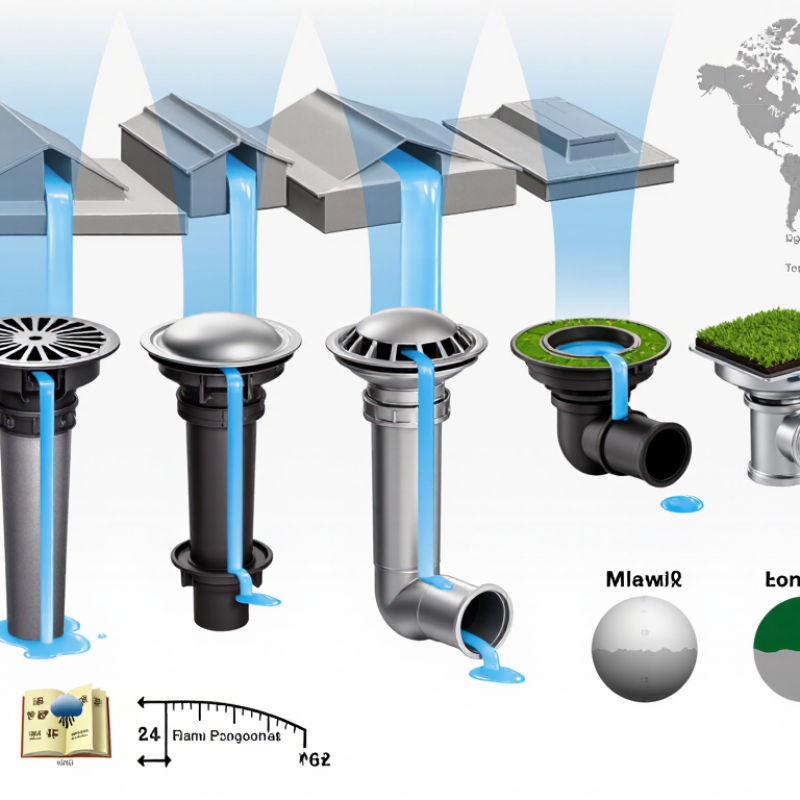
Top 10 Types of Roof Drains for Global Buyers

Roof Drainage Basics: Rainfall Intensity, Roof Area, Slope, and Flow Rate

Top 10 Types of Roof Drains for Global Buyers

Rainfall intensity is the starting point for every roof drainage decision. NOAA Atlas 14 provides precipitation-frequency estimates for many locations, but its data are not globally uniform. Buyers should use local storm records and national codes, not an average annual rainfall figure. The World Meteorological Organization reports that heavy precipitation is becoming more significant in many regions. Design storms deserve attention.

Flow rate depends on rainfall intensity, roof area, and runoff behavior. A practical SI calculation is Q = i × A × C ÷ 3600, where Q is liters per second, i is millimeters per hour, A is square meters, and C is the runoff coefficient. For a 500-square-meter metal roof receiving 100 mm/h rainfall, the estimated flow is about 13.9 L/s when C equals 1.0. Real roofs may differ.

Slope controls how quickly water reaches each drain. A shallow roof can create standing water, especially near deflected panels or blocked strainers. ASCE 7-22 and plumbing standards require attention to primary and secondary drainage paths, but local requirements vary. Drain sizing should also consider debris, thermal movement, and maintenance access. Bigger is not always safer. I have seen designs rely on a single rainfall assumption, then overlook emergency overflow capacity. That deserves a second check.

Top 10 Roof Drain Types Classified by Design, Material, and Installation

Roof drains differ by design, material, and installation method. The ten common types include flat-deck, siphonic, channel, scupper, overflow, dome, cast-iron, aluminum, stainless-steel, and HDPE drains. Flat-deck drains suit conventional low-slope roofs. Siphonic systems move water through full-bore pipes, reducing pipe diameter and ceiling congestion.

Channel drains help collect runoff near roof edges or long parapets. Scuppers discharge water through walls, while overflow drains provide a visible emergency path.

Material changes performance. Cast iron offers strong impact resistance and low movement. Aluminum is lighter and easier to handle. Stainless steel tolerates aggressive environments, but costs more. HDPE resists corrosion and supports welded joints.

Dome strainers help block leaves, although poorly maintained domes can still restrict flow. Small details matter.

NOAA Atlas 14 precipitation-frequency data should guide local rainfall calculations, not generic global averages. ASCE 7-22 uses site-specific rainfall intensity when engineers evaluate roof drainage and ponding risk.

NRCA technical guidance also separates primary drains from secondary drainage, especially on roofs with parapets. Installation affects reliability as much as material. Internal drains need secure clamping rings, insulation coordination, and accessible cleanouts. External scuppers need correct slope and protected discharge zones. Overflow outlets should remain visibly lower than vulnerable roof edges.

A common mistake is choosing a drain by diameter alone. Roof area, slope, rainfall intensity, debris, and thermal movement all matter.

No list is perfect. Local codes and field conditions can change the best choice.

Drainage Capacity Using the Rational Method: Q = C × i × A

Top 10 Types of Roof Drains for Global Buyers

Drainage Capacity Using the Rational Method: Q = C × i × A

For global buyers, roof drain selection starts with rainfall and roof geometry, not appearance. The Rational Method estimates peak runoff using Q = C × i × A. Here, Q means discharge, C means runoff coefficient, i means rainfall intensity, and A means roof area. Dome drains, siphonic drains, channel drains, scuppers, overflow drains, and guarded outlets suit different roof conditions. A green roof may need a protected outlet, while a large commercial roof may require several drainage points.

Consider a 500-square-metre roof with C = 0.9 and rainfall intensity of 100 millimetres per hour. The estimated peak flow is about 12.5 litres per second. That number describes incoming runoff, not the drain’s actual tested capacity. Compare it with outlet size, pipe slope, friction losses, debris exposure, and emergency overflow routes. Keep it accessible.

Rainfall intensity must reflect the project location and selected storm duration. An outdated rainfall chart can produce an unsafe design. The coefficient also needs scrutiny. Gravel, solar supports, ponding, or saturated planting can change runoff behaviour. I have seen clean calculations fail when leaves blocked a small strainer. The model is useful, but never perfect. Its weakest assumption may control the outcome. Review the drainage layout after construction and during maintenance planning.

Top 10 Types of Roof Drains for Global Buyers - Drainage Capacity Using the Rational Method: Q = C × i × A

No. Roof Drain Type Typical Installation Typical Runoff Coefficient
C
Illustrative Rainfall Intensity
i (mm/h)
Contributing Roof Area
A (ha)
Calculated Design Flow
Q (L/s)
Common Materials Key Buyer Considerations
1 Internal Flat-Roof Drain Low-slope roofs with concealed horizontal drainage pipes 0.85–0.95 150 0.10 39.6 Cast iron, stainless steel, aluminum, polymer-coated steel Check waterproofing flange, clamping ring, outlet diameter, and maintenance access.
2 Siphonic Roof Drain Large commercial or industrial roofs using engineered full-bore pipe flow 0.90–0.95 200 0.30 158.5 High-density polyethylene, cast iron, stainless steel Requires hydraulic engineering, correctly sized outlets, air baffles, and system commissioning.
3 Parapet Scupper Drain Openings through parapet walls that discharge to an external conductor or downspout 0.80–0.90 120 0.08 24.0 Aluminum, stainless steel, copper, galvanized steel Confirm wall sleeve dimensions, flashing compatibility, discharge direction, and freeze protection.
4 Secondary Overflow Drain Backup drainage for blocked or overloaded primary roof outlets 0.85–0.95 180 0.10 47.5 Stainless steel, aluminum, cast iron, molded polymer Set the overflow elevation independently from the primary drain and provide visible discharge where required.
5 Dome-Strainer Roof Drain Flat roofs where a raised dome prevents leaves and large debris from entering the outlet 0.85–0.95 150 0.06 22.5 Cast aluminum, stainless steel, cast iron, polypropylene Compare free-area ratio, dome height, strainer strength, and compatibility with roof membranes.
6 Gravel-Guard Roof Drain Ballasted roofs and built-up roofs with gravel or aggregate surfacing 0.75–0.90 100 0.05 11.8 Cast iron, stainless steel, aluminum, reinforced polymer Use a secure gravel stop, adequate clamping components, and a removable debris screen.
7 Balcony and Podium Drain Balconies, terraces, podium decks, and small exposed concrete roof areas 0.75–0.90 120 0.03 8.5 Stainless steel, cast iron, brass, polymer concrete, polypropylene Verify low-profile design, tile or paver interface, odor control, and accessibility for cleaning.
8 Gutter Outlet and Roof Leader Drain Pitched roofs that collect runoff in eaves gutters before discharge through downpipes 0.80–0.95 100 0.04 10.0 Aluminum, galvanized steel, copper, PVC, polypropylene Match outlet size to gutter capacity and downpipe flow; account for leaves, ice, and wind-driven rain.
9 Green-Roof Drain with Inspection Box Extensive or intensive vegetated roofs with drainage layers and maintenance access 0.30–0.70 100 0.12 16.7 Recycled polyethylene, polypropylene, stainless steel, aluminum Allow for root resistance, filter fabric, inspection-box access, substrate depth, and seasonal retention.
10 Emergency Overflow Scupper Independent emergency outlet that limits ponding depth during primary-drain blockage 0.85–0.95 200 0.15 79.4 Stainless steel, aluminum, copper, galvanized steel Provide a clearly visible discharge path and coordinate opening elevation with structural ponding limits.
Calculation basis: Q (L/s) = 0.00278 × C × i (mm/h) × A (ha). The flow values are illustrative design demands, not certified product capacities. Actual rainfall intensity, runoff coefficient, roof area, pipe configuration, blockage allowance, overflow requirements, and allowable ponding depth must be verified against the applicable local plumbing, building, and stormwater regulations.

Global Standards: EN 12056-3, IPC, and ASME A112.6.4 Requirements

Top 10 Types of Roof Drains for Global Buyers

Roof drainage selection starts with the governing standard, not the product shape. Common options include flat-roof, siphonic, overflow, dome, channel, balcony, deck, planter, emergency, and scupper drains. Each responds differently to rainfall, roof construction, debris, and maintenance access.

EN 12056-3 requires gravity roof drainage to follow local rainfall intensity and defined hydraulic assumptions. Designers should verify outlet capacity, pipe gradients, outlet spacing, and emergency discharge paths. A small roof pond can become a serious structural load. The calculation matters.

In the United States, the International Plumbing Code commonly works with listed roof-drain assemblies and local amendments. ASME A112.6.4 addresses performance and dimensional requirements for roof, deck, and balcony drains. Buyers should request test evidence, material specifications, and installation instructions. Standards alone do not guarantee a reliable installation.

The WMO State of the Global Climate 2023 reported that 2023 reached about 1.45°C above the 1850–1900 average, increasing attention on intense rainfall planning. NOAA Atlas 14 precipitation-frequency data remains a practical reference for many North American projects. Other regions need their own official rainfall records. A neat calculation can still fail. Field inspections often reveal blocked domes, undersized overflows, and poorly sealed joints. That assumption deserves challenge.

Top 10 Types of Roof Drains for Global Buyers

Reference relevance of EN 12056-3, IPC, and ASME A112.6.4 for common roof drainage types

The chart uses a reference indicator: 1 means the standard is commonly relevant to the drainage type, while 0 means it is not normally the primary reference. Final selection depends on rainfall intensity, drainage area, hydraulic calculation, roof construction, overflow provisions, local code adoption, and the certified product scope.

Buyer Selection Criteria: Outlet Size, Load Rating, Corrosion Resistance, and Maintenance

For global buyers comparing ten roof-drain types, outlet size should match rainfall intensity, roof area, and pipe capacity. NOAA Atlas 14 provides precipitation-frequency estimates for different return periods across the United States. Other regions require equivalent national rainfall records. A 100 mm outlet may fail when several drains share a blocked pipe. Bigger is not always better.

Load & Material Considerations Load rating matters on balconies, podium roofs, and maintenance routes. Check the drain body, grate, and surrounding deck as one system. ASCE 7-22 provides design loads, while local codes define drainage and overflow requirements. Corrosion resistance also depends on exposure. Coastal roofs need stainless steel or suitably protected materials. Industrial atmospheres may attack ordinary coatings faster than expected. The IPCC Sixth Assessment Report links a warming climate with more intense heavy rainfall in many regions. Drainage assumptions deserve review.

Tips: Request outlet-flow data, load-test results, coating specifications, and cleaning access details. Confirm compatibility with membranes and flashing materials. Inspect strainers after storms, not only during annual maintenance. FM Global Data Sheet 1-54 emphasizes reliable roof drainage and overflow protection for property-risk control. That guidance is practical, but it is not a substitute for local engineering. I have seen projects specify excellent drains, then leave no safe access for cleaning. That is a design failure worth questioning.