

What Are the Best Large Glass Windows From China?
Choosing the best large glass windows from China requires more than comparing photos and factory prices. It demands careful attention to engineering, manufacturing quality, energy performance, and installation conditions. A dramatic glass wall may look impressive online, yet perform poorly in a cold climate without suitable insulation and correctly designed frames.
This guide examines large glass windows through practical buying criteria. These include glass thickness, tempered or laminated construction, Low-E coatings, U-value, solar heat gain, frame strength, drainage, and wind-load calculations. Experienced suppliers should provide clear technical drawings, test reports, sample details, and traceable production records. Factory audits, video inspections, and independent quality checks can also reveal problems hidden behind polished sales presentations.
The best option is rarely the cheapest one. It should match the building’s size, climate, structure, safety needs, and local installation standards. A coastal project may require stronger corrosion resistance. A high-rise opening may need detailed pressure calculations. A family home may value quiet interiors more than maximum glass area. Small details matter, including spacer quality, gasket flexibility, corner joints, and hardware adjustment.
Some recommendations remain imperfect. Supplier claims can be difficult to verify, and product performance may change between prototypes and mass production. That is why written specifications and third-party inspections deserve serious attention. Buyers should compare several qualified manufacturers, request physical samples, and confirm warranty responsibilities before payment. With disciplined evaluation, Chinese manufacturers can offer reliable large glass windows without sacrificing design flexibility, durability, or long-term comfort.
What Defines a High-Quality Large Glass Window?
What Defines a High-Quality Large Glass Window?
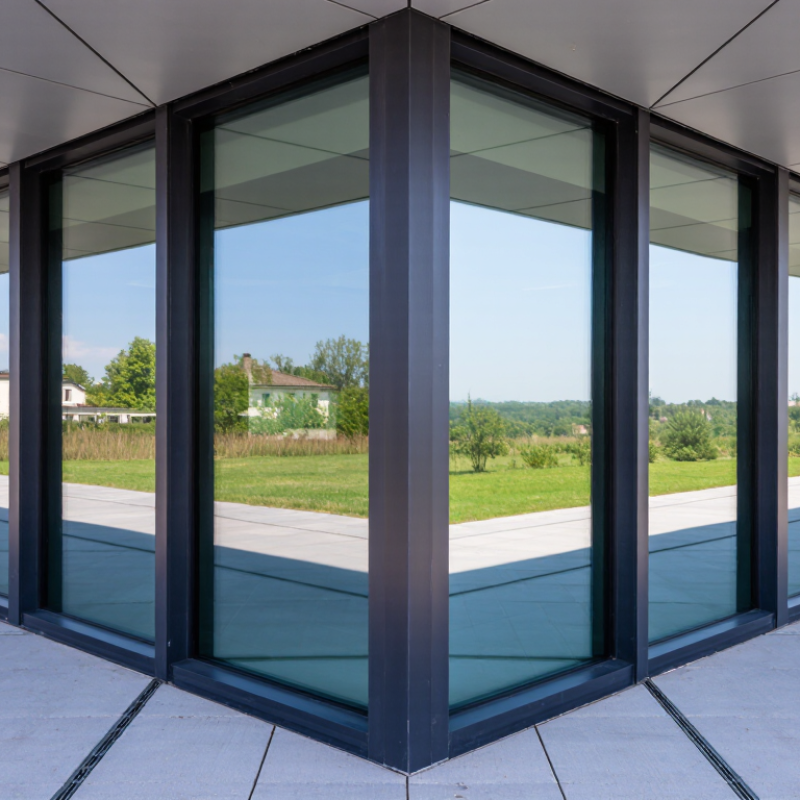
A high-quality large glass window begins with the correct glass specification. In project reviews, I check the climate, building orientation, and expected wind pressure. Double or triple glazing may improve comfort, but thickness alone does not guarantee performance. Low-E coatings can reduce heat transfer and glare. Tempered or laminated glass improves safety when breakage occurs. This matters in homes with children or busy public areas. Not optional. The frame also deserves close attention. A strong thermal break reduces cold edges and indoor condensation. Clean welds, even gaskets, and stable hardware show careful production. Test reports should state U-value, solar heat gain, air infiltration, water resistance, and wind-load results. Numbers matter more than polished photographs.
When sourcing large windows from China, I look for factory traceability and practical testing. A reliable manufacturer should provide material records, inspection procedures, and a full-size sample corner. Ask how the company handles a three-meter glass panel, not only a small showroom sample. Drainage paths, corner joints, and locking points need physical inspection. Installation is another weak link. A window can leave the factory perfectly assembled and still leak after poor alignment. This is often overlooked. Independent inspection can reveal small frame distortions or uneven sealing. I would not treat every certificate as complete proof; documents can be outdated or incomplete. My judgment can be imperfect, so I compare test data, samples, and site feedback before approving a purchase.
What Are the Best Large Glass Windows From China? - What Defines a High-Quality Large Glass Window?
| Quality Dimension | Recommended Specification for Large Windows | Typical Performance Data | Why It Matters |
|---|---|---|---|
| Glass Configuration | Double or triple insulating glass units with sealed cavities | Common cavity widths: approximately 12–20 mm for double glazing and 8–16 mm per cavity for triple glazing | Multiple panes and sealed cavities reduce heat transfer and improve indoor comfort. |
| Low-E Coating | High-quality, uniform low-emissivity coating selected for the local climate | Double glazing with low-E glass can achieve a center-of-glass U-value of roughly 1.0–1.6 W/m²·K, depending on construction | The coating limits radiant heat loss in cold weather and can reduce solar heat gain in hot climates. |
| Thermal Insulation | Thermally improved frame, warm-edge spacer, and properly sealed insulating glass | Whole-window U-value is commonly higher than center-of-glass performance; the exact result depends on frame, size, glazing, and installation | Frames and edge spacers can become thermal weak points in very large glazed areas. |
| Safety Glass | Heat-strengthened or fully tempered glass; laminated glass where fall, impact, or overhead safety is required | Tempered glass is approximately four to five times stronger than annealed glass in bending; laminated glass retains fragments after breakage | Large panes require better resistance to impact, thermal stress, wind load, and human contact. |
| Acoustic Performance | Asymmetric laminated or insulating glass for projects near roads, airports, or dense urban areas | Typical acoustic ratings may range from approximately 30–45 dB, depending on glass thickness, air space, frame, and installation | Larger windows can transmit more external noise unless the complete window assembly is acoustically designed. |
| Solar Control | Solar-control low-E glass matched to orientation, latitude, shading, and cooling requirements | Solar heat gain coefficient commonly falls within approximately 0.25–0.60, depending on coating and glazing construction | A suitable SHGC helps balance daylight, glare, cooling loads, and winter solar heat. |
| Visible Light Transmission | Select a light-transmission level that supports daylight without excessive glare | Typical values range from approximately 35% to 75%, depending on tint, coating, and number of panes | Higher transmission improves daylight, while lower transmission may improve solar and glare control. |
| Wind and Structural Design | Project-specific calculation based on pane dimensions, building height, exposure, local wind speed, and support conditions | Glass thickness and makeup are determined by structural calculations rather than window size alone | Large glass panels experience greater deflection and load, so generic thickness selection is unsafe. |
| Air and Water Tightness | Continuous weather seals, correctly drained frames, durable gaskets, and tested corner joints | Performance should be verified through air-infiltration, water-penetration, and wind-pressure testing under the applicable project standard | A high-performance glass unit cannot compensate for weak seals or poor frame drainage. |
| Insulating Glass Durability | Uniform primary and secondary seals, clean assembly conditions, and moisture-resistant spacers | Quality control should include seal inspection, cavity cleanliness, gas-fill verification where applicable, and condensation-resistance checks | Poor sealing can cause condensation between panes, coating degradation, and loss of insulating performance. |
| Optical Quality | Low visual distortion, consistent color, clean surfaces, and no visible scratches, bubbles, cracks, or edge damage | Inspection should be performed under agreed lighting, viewing distance, acceptance criteria, and applicable glass standards | Distortion becomes more noticeable across wide or tall panes and can affect architectural appearance. |
| Maximum Panel Size | Size confirmed by glass thickness, processing capability, transport limits, frame system, and structural calculations | Large-format panes may exceed 3 m in one direction, but allowable dimensions vary significantly by design and equipment | The largest possible pane is not always the safest or most economical option. |
| Installation Quality | Accurate opening dimensions, adequate setting blocks, controlled clearances, compatible sealants, and professional alignment | Installation tolerances must follow the selected frame system and project specifications; the glass should not carry unintended building movement | Incorrect installation can cause glass breakage, air leakage, water entry, and premature seal failure. |
| Documentation and Testing | Technical drawings, glass build-up, test reports, inspection records, and traceable quality documentation | Documentation should identify dimensions, thickness, coating position, safety treatment, performance values, and inspection results | Transparent records make it possible to verify that delivered windows match the approved design. |
Note: Actual performance depends on the complete window system, including glass, frame, spacer, seals, hardware, building orientation, local climate, structural loads, and installation. Final specifications should be confirmed through project-specific calculations and applicable testing standards.
Related Posts
-
What Is the Best Glass for Large Glass Windows?
-
Top 10 Tips for Choosing the Best Front Windows for Your Home?
-

2025 Top 5 Patio Doors with Windows: Enhance Your Home's Style & Energy Efficiency
-
2026 Best Front Windows for Your Global Sourcing Needs?
-
2026 Best Premium Doors and Windows: Top Choices for Your Home
-

2026 Top Green Windows Trends for Global Buyers?